Home → The Built World → Entry
The Built World · Register entry
Tactile Paving That Lies
When the blister is in the wrong place, a blind pedestrian learns to trust a signal that is wrong. That is more dangerous than no signal at all.
- Measure
- Tactile Paving That Lies
- Where it bites
- The crossing
- Signed off by
- Highways authority and contractor
- Order of cost
- Re-laying works
What the standard requires
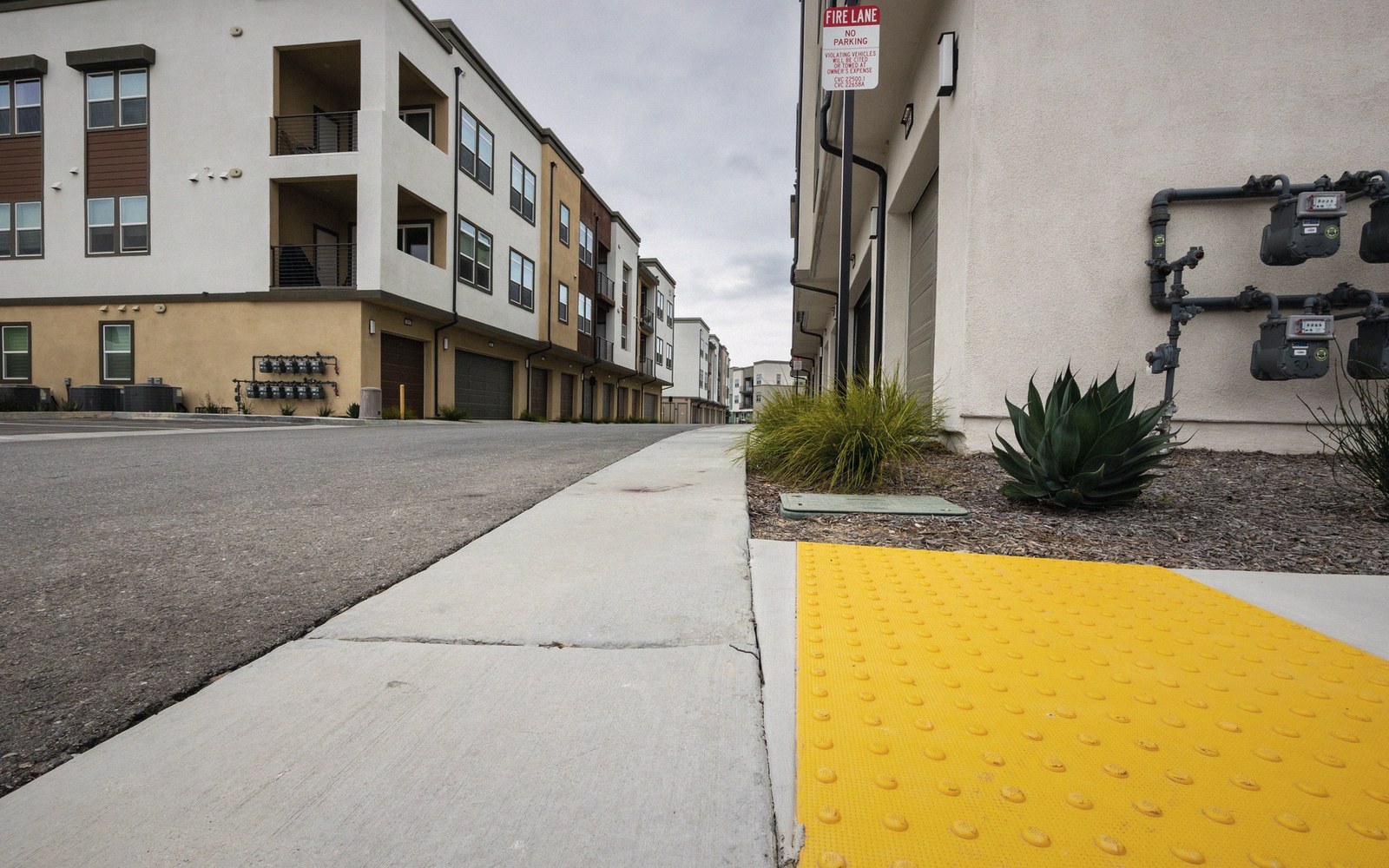
Tactile paving exists to carry information through the sole of a shoe or the tip of a cane. Blister paving — the domed, grid-pattern surface — marks a hazard at a controlled crossing. Corduroy paving — parallel ribs — warns of a hazard ahead: steps, a platform edge, a level change. Offset blister marks an uncontrolled crossing. Each pattern means something precise, and that precision is the point. A blind pedestrian or a partially sighted one navigating a busy urban environment is not decorating a route; they are reading it.
In England and Wales, the Department for Transport's Guidance on the Use of Tactile Paving Surfaces sets out exactly where each surface goes, what colour it must be, how far it must extend and at what gradient. The standard isn't advisory decoration. When a cane user learns to read blister as 'safe to cross here', they depend on every future installation saying the same thing. The value of the system is its consistency.
Where it goes wrong
Urban audits — carried out by organisations including the Guide Dogs charity and local authority access officers — consistently find the same cluster of failures. Blister placed at a dropped kerb that serves a vehicle access rather than a crossing. Corduroy installed on a flat, hazard-free path, apparently because someone had material left over. Yellow tactile on a background of pale concrete where the visual contrast falls well below the required 30-point light reflectance value (LRV) difference, making it invisible to someone with low vision. Units laid with the ribbing running the wrong direction. And, pervasively, patches where one or two blister units have been lifted and not replaced after utility works, leaving a gap where the message stops mid-sentence.
Each of these is a navigation error waiting to happen. But there is a subtler harm. A pedestrian who uses tactile paving as primary wayfinding and encounters a wrongly placed blister learns — through repeated experience — that the signal is unreliable. At that point they face a choice: continue trusting a system that sometimes lies, or stop using it and lose whatever guidance it legitimately provides. Neither option is acceptable. The installation failure has not merely failed to help; it has actively degraded a person's ability to navigate the environment.
Maintenance is where good installations most often collapse. Local highway authorities carry responsibility for tactile surfaces on the public highway, but post-utility reinstatement — where a contractor digs up a footway and reinstalls the surface — is a chronic source of errors. The specification for reinstatement is clear; the inspection of whether it was followed is inconsistent. A surface returned with ribbing reversed or blister units rotated 45 degrees is not a tactile surface. It is noise.
What procurement and commissioning need to require
The fix is not complicated. Specifications at procurement stage need to name the DfT guidance explicitly and require compliance as a condition of acceptance, not a design aspiration. Inspection at practical completion must include tactile surfaces as a named check, not a box ticked because paving was laid. For highway works, post-reinstatement sign-off should verify orientation, contrast and completeness before the contractor leaves site.
Designers and access auditors should include tactile surfaces in every external audit — not as a courtesy item at the end, but as a safety-critical check near the top. The question is not 'is there tactile paving?' but 'does it say the right thing, in the right place, in the right language?'
A blank pavement is honest. A lying one is a hazard built to look like help.
Related entries
Same file, different signature.